What is an industrial sieve?
An industrial sieve is a piece of process equipment that separates particles by size using a perforated screen or mesh. Particles smaller than the screen aperture pass through; larger particles are retained. Industrial sieves serve two main purposes: safety screening (removing foreign objects, agglomerates and contamination from product streams) and grading or classification (separating products into specific size fractions for downstream processing or sale). Industrial sieves are typically specified by screen diameter, mesh size (or aperture in microns), throughput (kg/hr), drive type and contact materials, with selection driven by particle size range, throughput requirement and product handling characteristics.
How long do industrial sieves last?
Quality industrial sieves routinely operate for 20-30+ years. The frame, motor housings and structural components last decades; screens are wear consumables typically replaced every 3-12 months depending on duty (abrasive products drive faster wear). Drive motors, springs and dampers are routine maintenance items.
Why choose an industrial sieve?
Sieving is essential to product quality, safety and process integrity across virtually every industry that handles powders or granules.
- Foreign body protection: safety screening removes contamination, packaging fragments and foreign objects from incoming materials, supporting HACCP, FSMA and food safety compliance.
- Particle size classification: screening separates products into specific particle size fractions, supporting downstream process requirements and customer specifications.
- Quality assurance: in-line sieving catches agglomerates, lumps and oversize particles before they reach packaging, protecting product quality and customer satisfaction.
- Process protection: upstream sieves protect downstream equipment (mills, mixers, fillers, packaging machines) from oversize particles that could cause damage or downtime.
- Continuous high-throughput operation: modern industrial sieves operate continuously at throughputs from 50 kg/hr up to 50+ tonnes/hr, supporting virtually every production scale.
Why buy a used industrial sieve?
Industrial sieves are good candidates for second-hand purchase because the main mechanical components last for decades.
- Significant cost savings: used industrial sieves typically cost 40-60% less than new equivalents.
- Immediate availability: new specialty sieves can have lead times of 8-12 weeks. Used stock is often available within days or weeks.
- Refurbishment-friendly: screen replacement, motor service, spring/damper renewal and seal updates return used sieves to as-new performance.
- Proven track record: sieves with documented operating history give clear evidence of duty cycle and product compatibility.
- Strong UK aftermarket: established brands such as Russell Finex, Sweco, Kason, Tema and others have strong UK service support.
Types of industrial sieves for sale
Vibratory sieves and separators
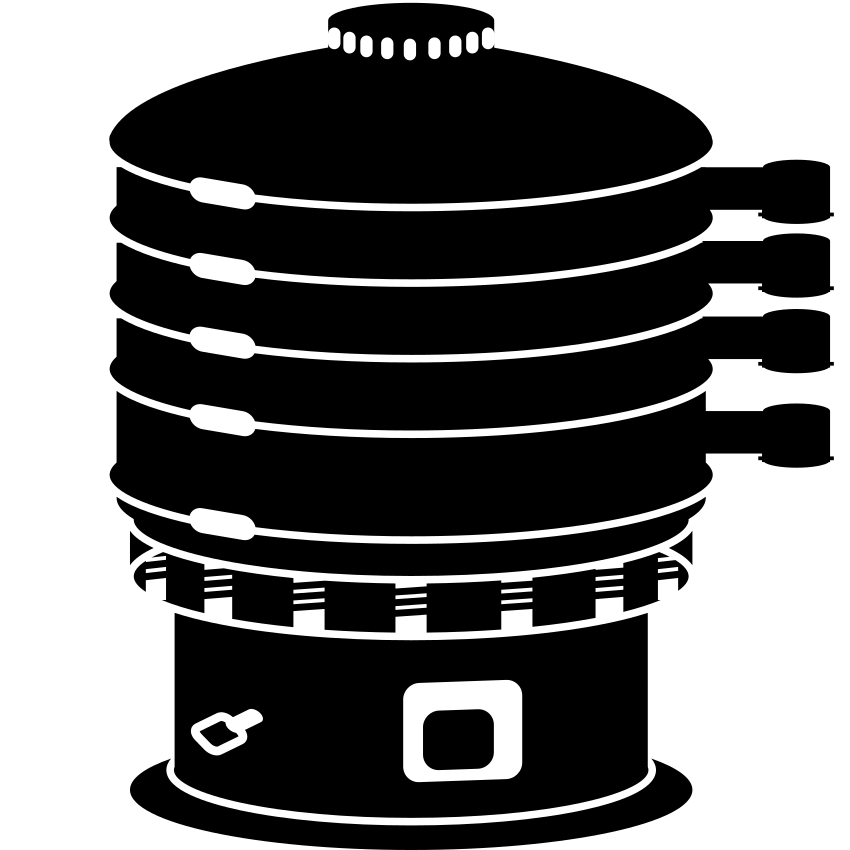
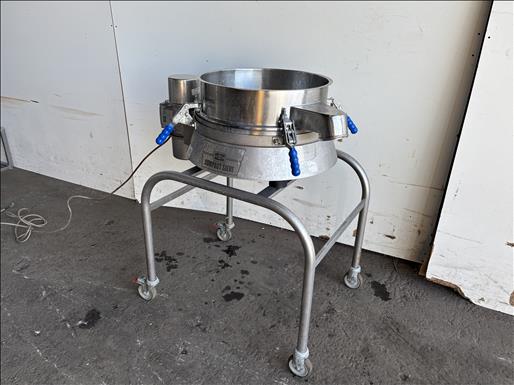
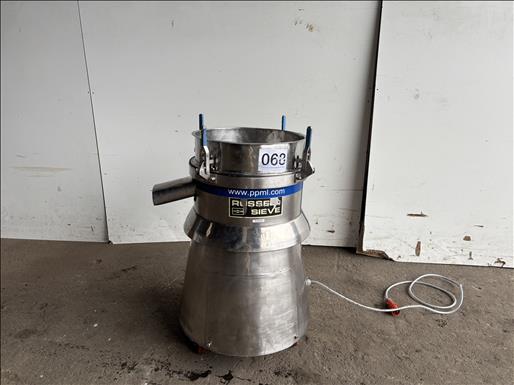
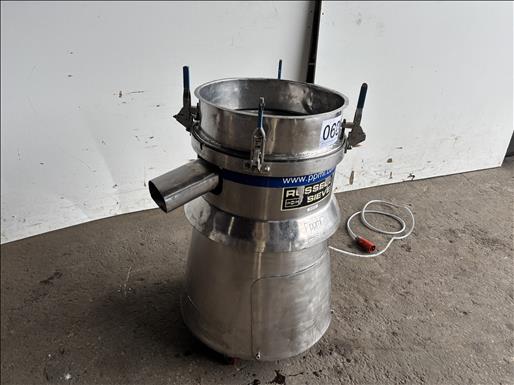
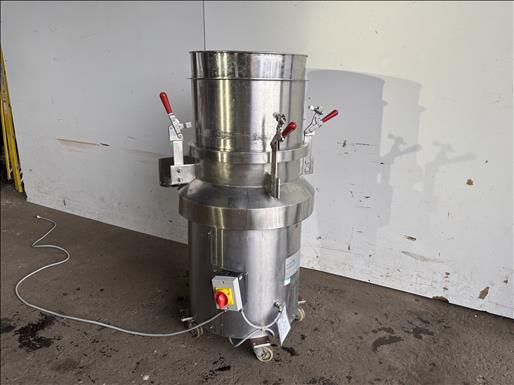
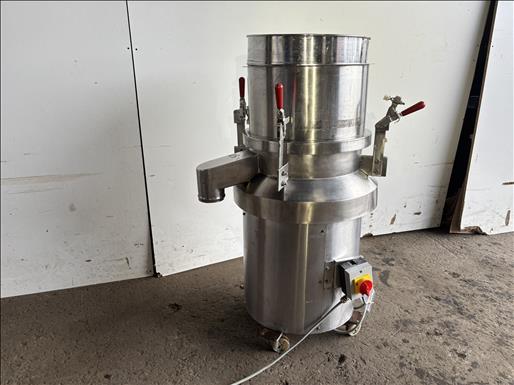
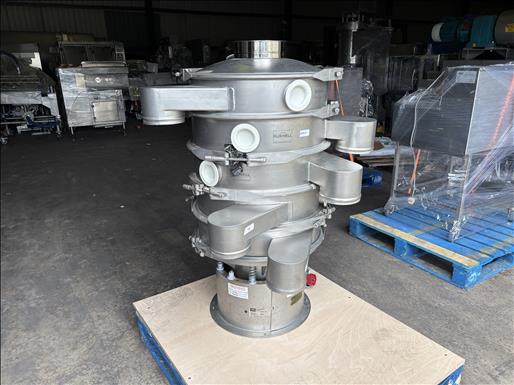
Round vibratory sieves with multiple deck options are the most common industrial screening type. Common manufacturers include Russell Finex, Sweco, Kason, Vibra-Schultheis and Allgaier. Sizes range from 600mm diameter laboratory units up to 2.4m+ production sieves. Suit safety screening, classification and dewatering applications across food, pharmaceutical, chemical and recycling industries.
Centrifugal sifters
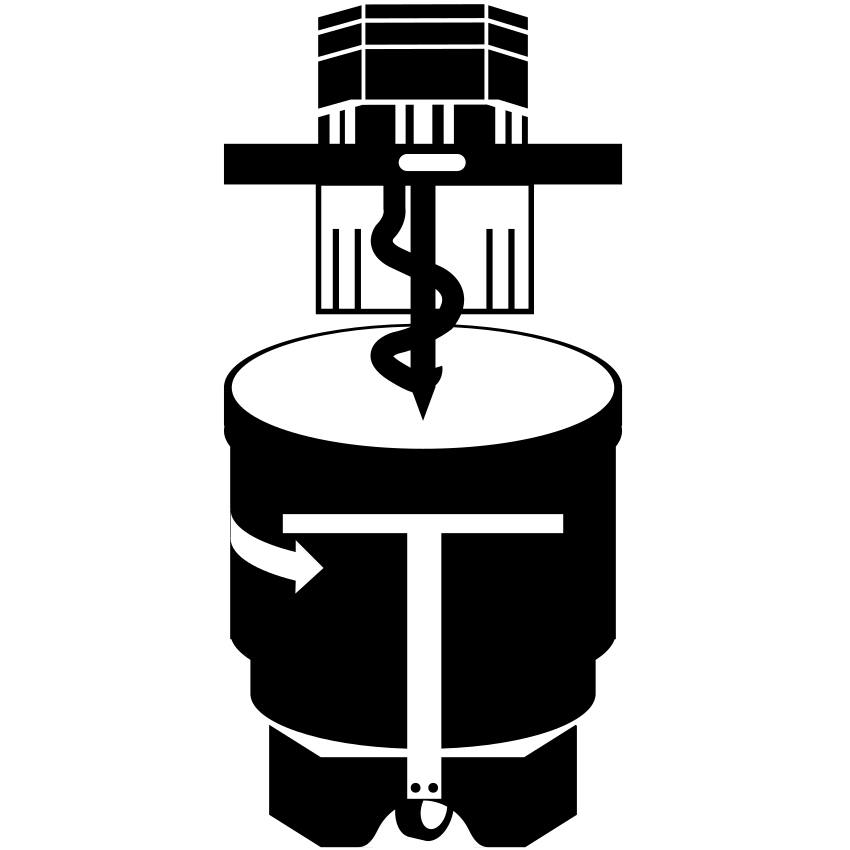
Centrifugal sifters use a rotating paddle inside a cylindrical screen to push product through the apertures, supporting very high throughputs of free-flowing powders. Russell Finex Compact, Kason Centri-Sifter and similar designs handle up to 50+ tonnes/hr. Common in flour milling, sugar, animal feed, plastics and pharmaceutical bulk handling.
Gyratory sifters
Rectangular gyratory sifters provide horizontal screening motion with multiple decks for simultaneous classification into several size fractions. Common in flour milling, animal feed, sugar processing and high-volume bulk classification. Manufacturers include Buhler, Allgaier, Kason and specialist UK builders.
Tumbler screens and tumbler sieves
Tumbler screens use three-dimensional motion combining horizontal and vertical components to deliver gentle, accurate classification into multiple fractions. Allgaier and Russell Finex are major manufacturers. Common for difficult-to-screen products and applications requiring high accuracy.
Linear motion screens
Linear vibratory screens provide straight-line motion for high-volume screening, dewatering and classification. Common in mineral processing, recycling, aggregates and large-scale industrial classification.
In-line and pipeline sieves
Compact in-line sieves install directly in pneumatic conveying lines or pipelines, providing continuous safety screening of powders without breaking the conveying flow. Common in food, pharmaceutical and chemical bulk handling.
Key features to consider when buying an industrial sieve
- Screen size and throughput: match screen diameter and number of decks to your throughput target. Larger screens deliver higher capacity but at greater capital cost and footprint.
- Mesh size and aperture: specify the cut size needed for your separation. Standard mesh series (Tyler, ASTM, ISO) define apertures in microns or mesh count.
- Materials of construction: 316L stainless for food, pharmaceutical and most chemical duty; carbon steel for benign service; specialist coatings for highly abrasive products.
- Drive type and motion: circular vibration, gyratory, tumbler and linear all suit different products. Match motion to your particle size range, shape characteristics and screening efficiency target.
- Mesh material: stainless steel woven wire is most common; nylon or polyester for non-magnetic and food applications; specialist coatings for sticky or fragile products.
- Hygiene and certification: food and pharma sieves need 3A, EHEDG or FDA-aligned design with sanitary fittings and documented cleaning validation.
- ATEX rating: essential for combustible dusts, including sugar, flour, pharmaceutical APIs and many polymers. Always verify current certification.
Industries and use cases for industrial sieves
- Food and beverage: safety screening of flour, sugar, ingredients, powders and instant products; classification of grains and milled products.
- Pharmaceutical and biotech: safety screening of APIs, excipients, granulated products and packaged medicines under GMP-compliant operation.
- Chemicals and pigments: classification of chemical powders, pigment sizing, agrochemical screening and specialty chemical preparation.
- Plastics and polymers: regrind classification, virgin polymer pellet screening, masterbatch sieving and recycling preparation.
- Mineral processing and aggregates: classification of cement, lime, gypsum, fertilisers, minerals and aggregates.
- Recycling and waste: screening of recyclate streams, dewatering of slurries and classification of biomass and waste materials.
What locations do we serve for industrial sieves?
As a buyer-to-seller marketplace, we feature industrial sieves from sellers across the UK and beyond. Use our location and distance filters to find equipment near your facility, supporting site visits and reducing transport costs on heavy production-scale sieves.
Can I return an industrial sieve?
As we operate as a buyer-to-seller marketplace, any returns policy must be agreed directly with the seller before purchase. We’d recommend pre-purchase inspection wherever possible, including assessment of frame condition, drive operation, screen condition and any vibration or balance considerations.
Browse other industrial machinery categories
This category forms one part of our wider industrial machinery marketplace. Browse the full range of New and Used Industrial Machinery, or jump into a specific sub-category below: